
Articles
A Taste of Belonging: How Food Helped This Thai Immigrant Call Singapore Home
13 February 2026
10 years after arriving, Thai-born singer-turned-chef Bird can say she has integrated into Singaporean life while honouring her cultural identity. One way she has done so is through her Thai-style yu sheng, weaving her heritage into local Chinese New Year traditions.
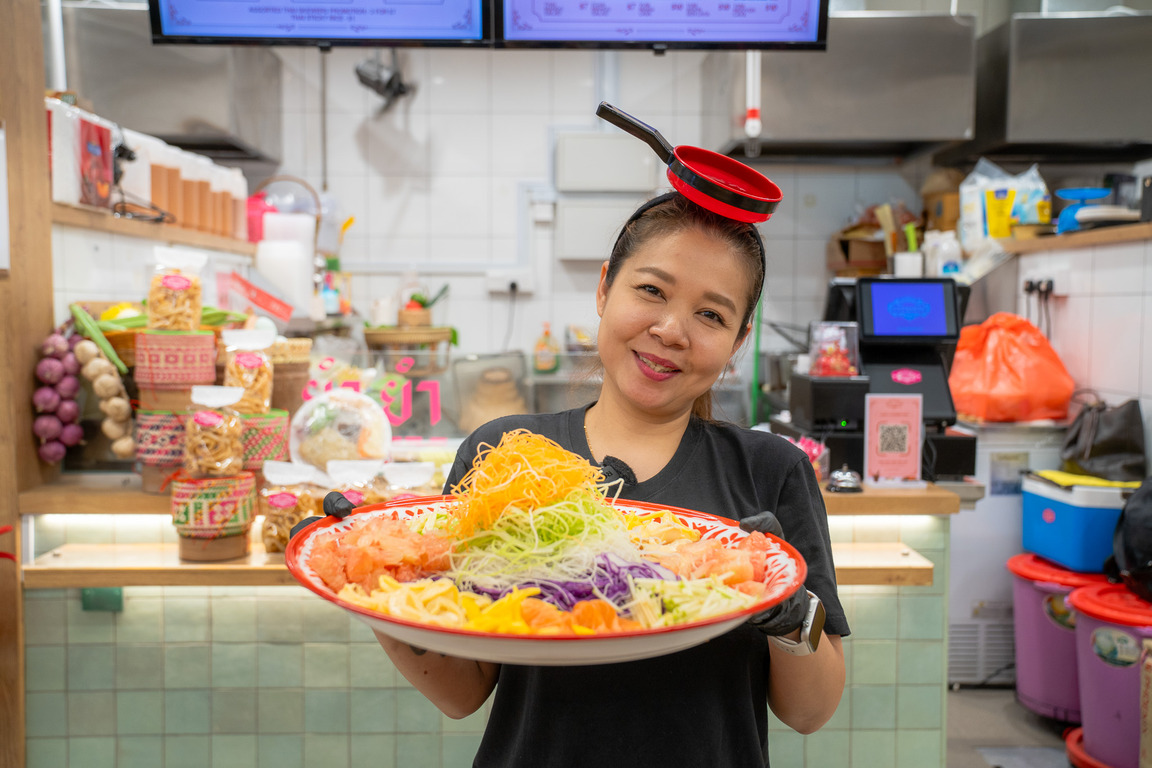
Bird with her Thai-style yu sheng.
Meet 40-year-old Bird. She is the store manager of two take-and-go food stalls: Yum Yum Tod Tod (serves Thai salad and grilled skewers) and Pad Pad Thai (dishes out Thai street food cooked on a hot wok).
She is married to a Singaporean and has lived in the Lion City for 10 years and counting. Every year, her family looks forward to her signature plate of Thai-style 鱼生 (yu sheng).
Food is deeply personal and a marker of identity. For Bird, nothing illustrates her integration into Singapore more clearly than her unique yu sheng and changing relationship with food.
Searching for a better life: Difficulties adjusting to a new home
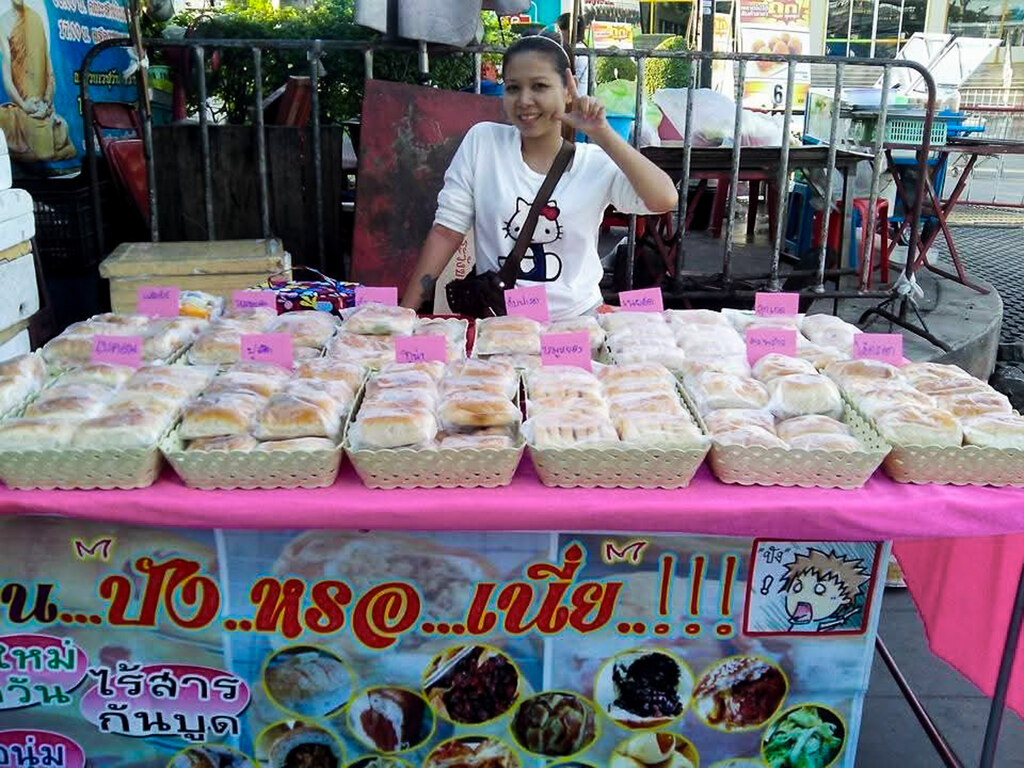
Bird selling bread in Bangkok. Photo credit: Bird.
Born in Nong Khaem, the westernmost of Bangkok’s 50 districts, the oldest of three siblings decided to leave the Thai suburb in hopes of earning higher pay. She arrived in Singapore in 2016 and began working as a singer at a siam diu (Thai disco club).
Bird’s first three years here were a whirlwind. The long nights working from 9pm to 5am were tough on her, and she struggled to adjust to the hawker fare.
“When I first moved, I didn't touch any local food for the first two years. I only like Thai food with strong flavours – sour, spicy, and sweet. Even when I ate out, I would bring my own chilli, sugar, and fish sauce, all the seasonings, to adjust the dish to my liking,” Bird recalled.
The nightlife scene wasn’t easy, but it had a silver lining: it’s where she met her husband, a Singaporean who later became her partner in life and home.
Embarking on new starts: Venturing into F&B
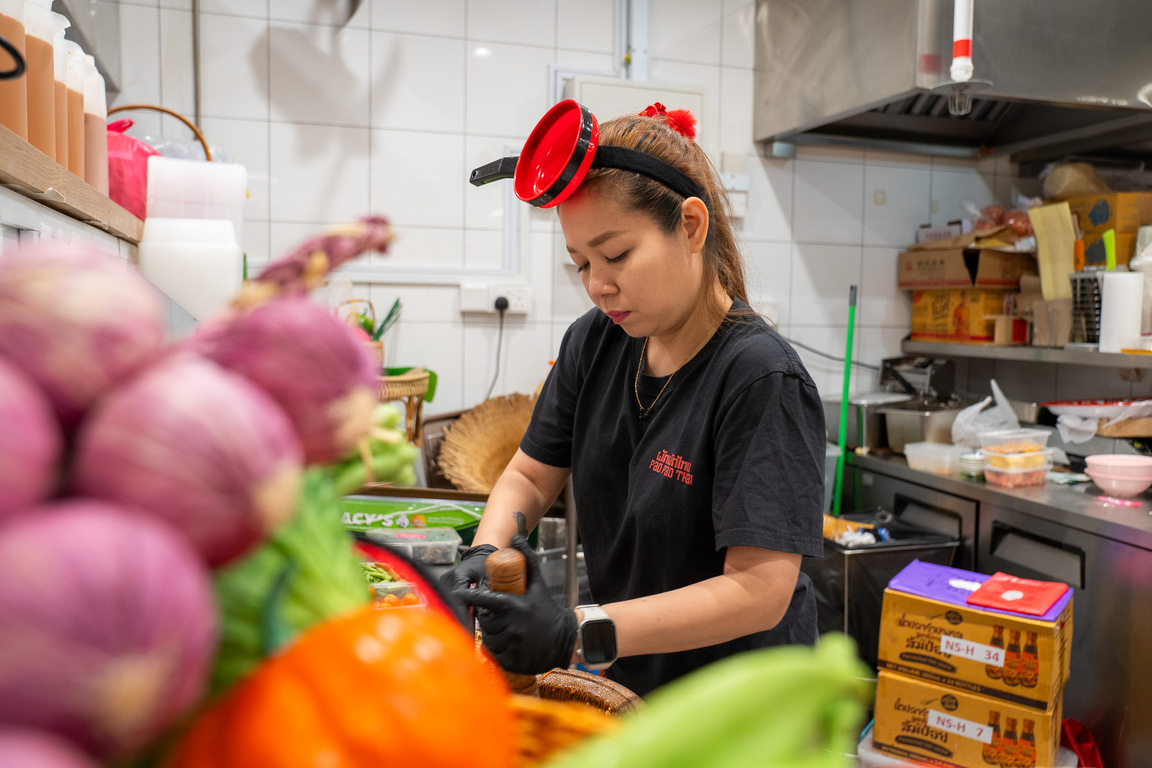
Bird making Som Tam in Yum Yum Tod Tod.
Soon after, Bird traded her job in the nightlife scene for one with regular hours. She started as a chef, cooking Thai food at an F&B outlet. In time, she worked her way up to a managerial position.
“I went into the F&B industry because I loved cooking from a young age. Everything I know I learnt from my grandmother. I remember the first thing she taught me to cook was Nam Prik Kapi (วิธีทำ น้ำพริกกะปิ), a spicy shrimp chilli dip,” Bird remarked.
When sourcing ingredients, she would head to Thai Supermarket @ Aperia Mall (formerly located at Golden Mile Complex). There, Bird met Wan Ting, her current boss.
Back in March 2025, Wan Ting was working as the Marketing Communications Lead at Thai Supermarket; she was looking for someone to take over an empty stall. Eventually, she hired Bird.
“At first, our relationship was purely professional. But over time, we became closer. Bird has proven to be incredibly reliable and consistent. I’ve supported her beyond work, where I can – checking in on her wellbeing, helping her settle in, and making sure she has a stable base while she’s here,” Wan Ting shared.
Together, the pair tweaked recipes and put together a menu they were proud of – one that stayed true to authentic Thai flavours while appealing to the Singaporean palate. It was around the same time that Bird also started eating more local foods to understand the Singaporean palate better.
“I'm really lucky to have Thai Supermarket and Wan Ting to help me. I really want to bring the taste of Thailand here so that everyone can enjoy it,” said Bird.
“For all she has done for me, I’m very grateful. Now I cook for everyone. I’m living my dream.”
Celebrating Chinese New Year in Singapore
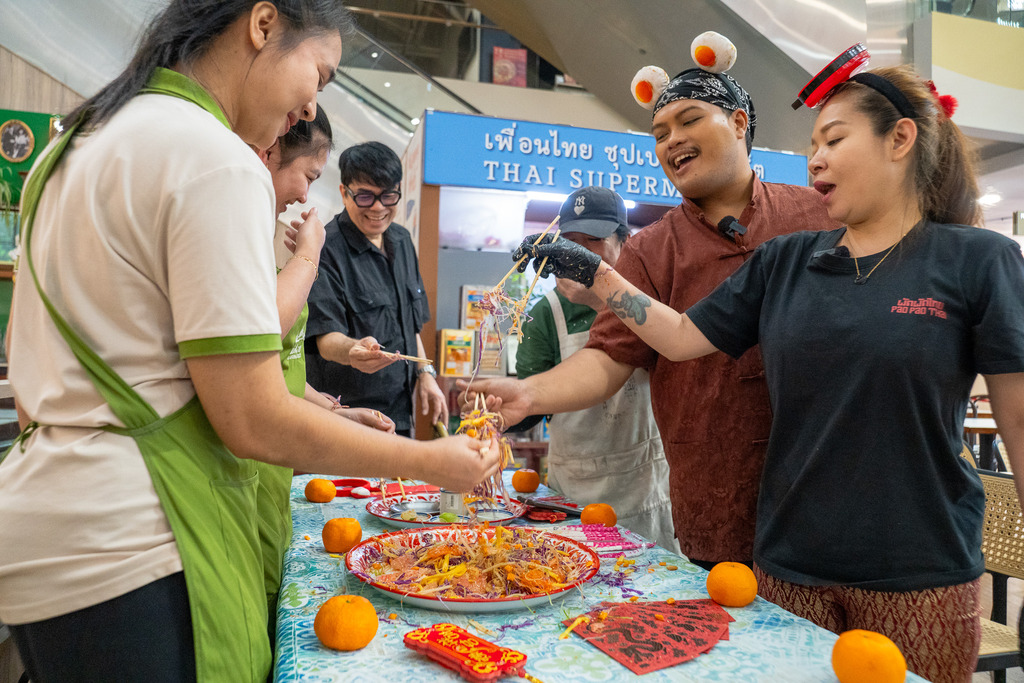
Bird (right) tossing yu sheng with her Thai and Singaporean friends (left).
In 2019, Bird got married and celebrated her first Chinese New Year as a new daughter-in-law.
“In Thailand, we usually just pray and then order in food to eat as a family. Here, we hold an open house for relatives to visit, cook, and prepare food and drinks. Then, I need to bring oranges to ah ma.
When visiting, I just say ‘恭喜发财, 红包拿来’ (gong xi fa cai, ang pao na lai; wishing you prosperity, now give me a red packet) and ‘身体健康’ (shen ti jian kang; wishing you good health) and give two oranges. Huat ah!”
Despite being away from her homeland, Bird wanted to bring a piece of Thailand to the Chinese New Year festivities.
So, one year, she served a Thai-style yu sheng, swapping Chinese ingredients for Thai counterparts that carry the same or similar positive meanings. It proved a hit and she has done it ever since.
Enjoying yu sheng with a twist
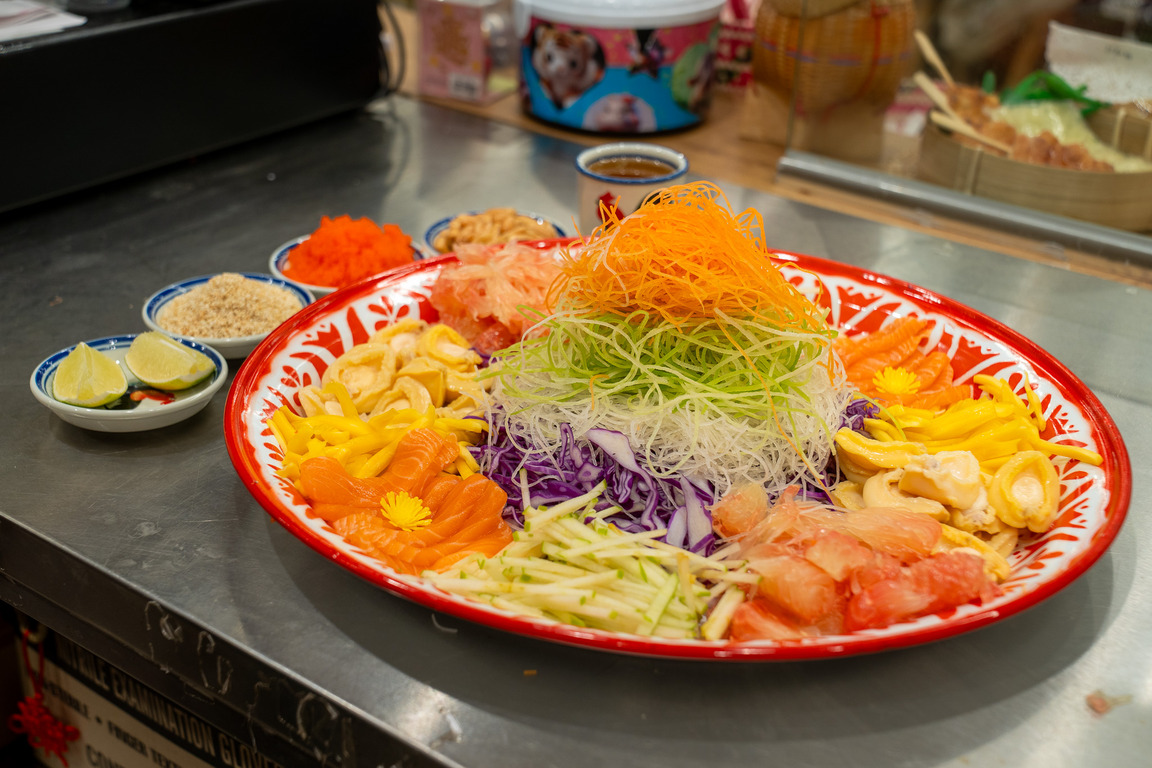
Bird’s finished Thai yu sheng.
In Singapore, yu sheng is eaten for good luck. Ingredients are added one by one, each paired with an auspicious blessing. Then, it is tossed as high as possible – the higher it is tossed, the greater the prosperity.
It typically comprises thin, uncooked fish slices, and a variety of vegetables such as shredded carrots, white and green radish, and pickled ginger slices. Toppings include crushed peanuts, pomelo, crackers, pepper, cinnamon, oil, sugar and more.
Aside from the usual fish and abalone, Bird would use prawn roe in her special yu sheng as it signifies “having gold’ and “to be rich” in Thai culture.
Green apple is also added to the fusion dish as eating green-coloured foods represents health, vigour and eternal youth. Jackfruit is also included.
“Jackfruit is known as ‘khanun’ (ขนุน); it sounds like ‘noon’ (หนุน) which means to support, strengthen. Like, there will always be someone to support you in life. Plus, it’s the colour of gold for good fortune and success!” Bird explained.
Embracing Singapore as home
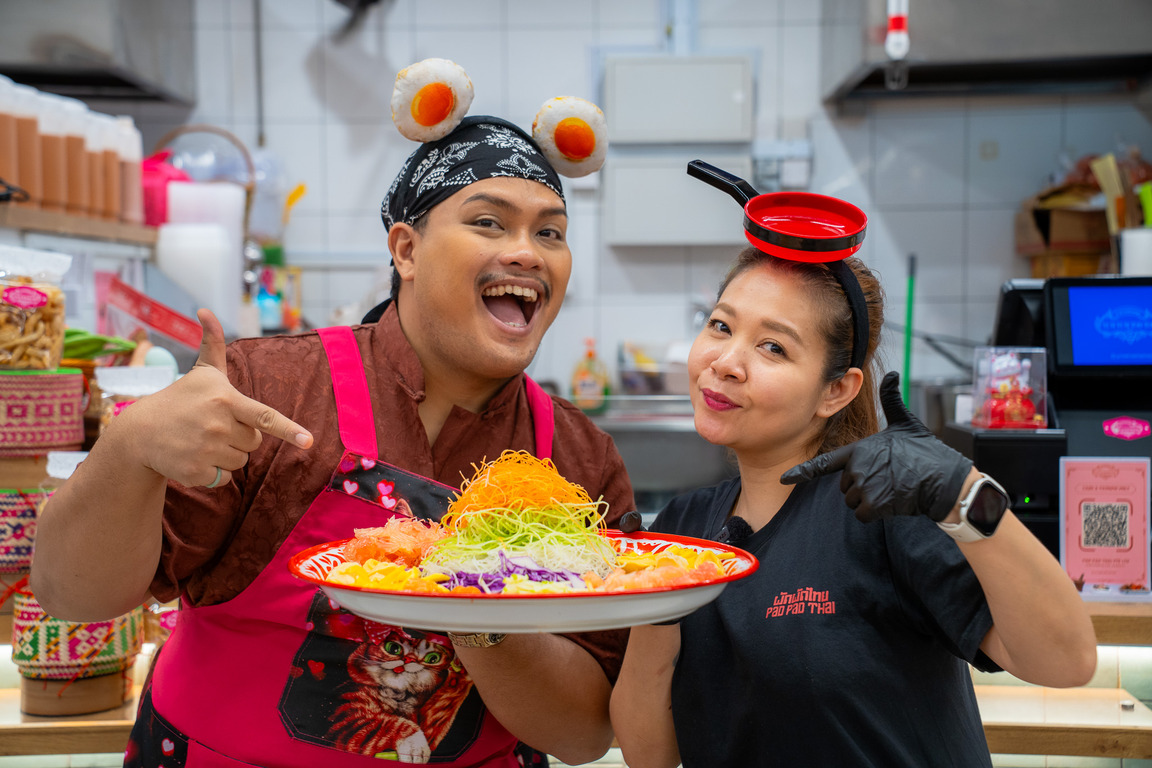
Bird posing with Singaporean culinary content creator, Azfar.
After a decade in the Lion City, Bird has come a long way from shunning food at kopitiams. Now, she happily slurps up her favourite prawn noodles with soup.
She has learnt to handle the spice of chilli padi and asks for “extra, extra, extra chilli”. She can taste and explain the differences between Chinese, Malay and Indian chicken curry recipes.
“Maybe I’ve stayed too long, but the only thing I miss about Thailand is my family. I like how Singapore takes care of its people. Everything is clean, organised, and proper.
Here, I have Thai friends but also a lot of Singaporean friends. They teach me English and Chinese, help me get around, and support my business. So yes, I hope to be a Singapore citizen!”