
Articles
Rolling Into Boccia: Staying Sharp Through Adaptive Sports
27 July 2026
Through strategy, friendship and the kampung spirit, 68-year-old Adam Bin Ramli and 75-year-old Ong Soon Kim share how Boccia and adaptive sports have kept them active, connected, and enriched their lives.
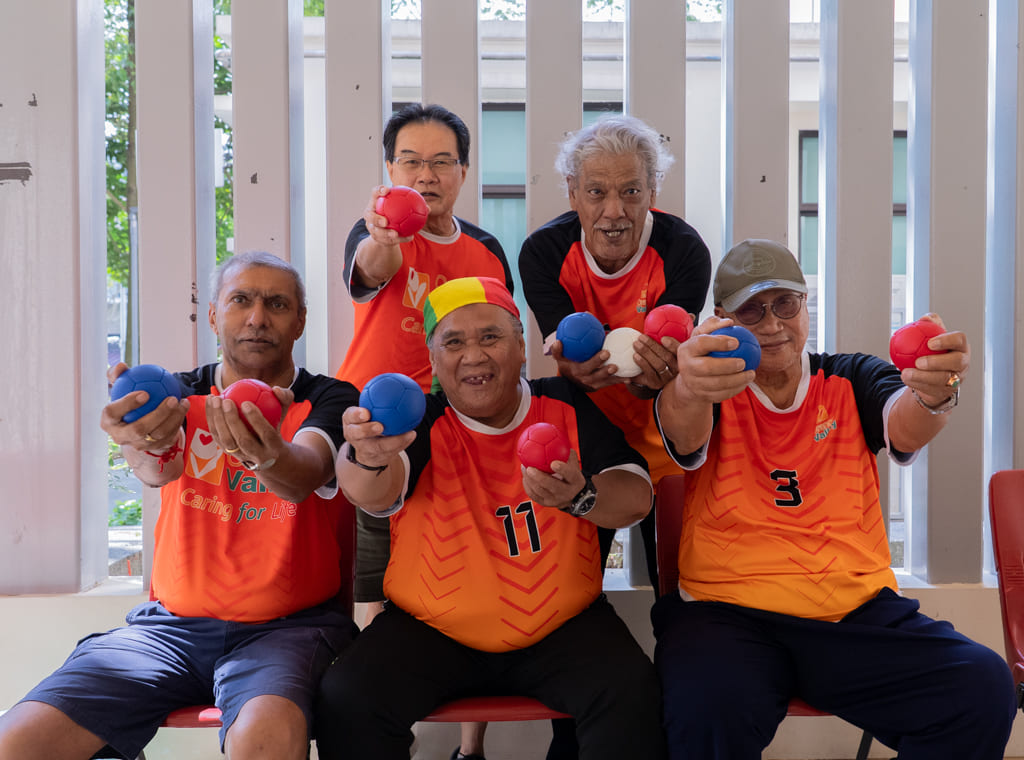
Orange Valley Active Ageing Centre @ Woodlands Peak Boccia Team
Boccia (pronounced “Bo-cha”) is a relatively new sport in Singapore, but it has been steadily gaining popularity among elderly persons looking to stay active, connected and mentally engaged.
Originally developed as an inclusive sport for persons with cerebral palsy, Boccia is designed to be enjoyed by anyone, regardless of their mobility. Its emphasis on strategy and precision over physical strength has also made it accessible and appealing to seniors like Adam Bin Ramli and Ong Soon Kim.
Adam has been playing Boccia for two years, while Soon Kim is newer to the game, having tried the sport just one year ago. They are “68 and 75 years young”, respectively, and are part of the five-man-strong Orange Valley Active Ageing Centre @ Woodlands Peak Boccia Team.
For the duo, what started as a novel and fun recreational activity has gradually become a rich source of friendship, learning and community.
More than just a game: understanding Boccia
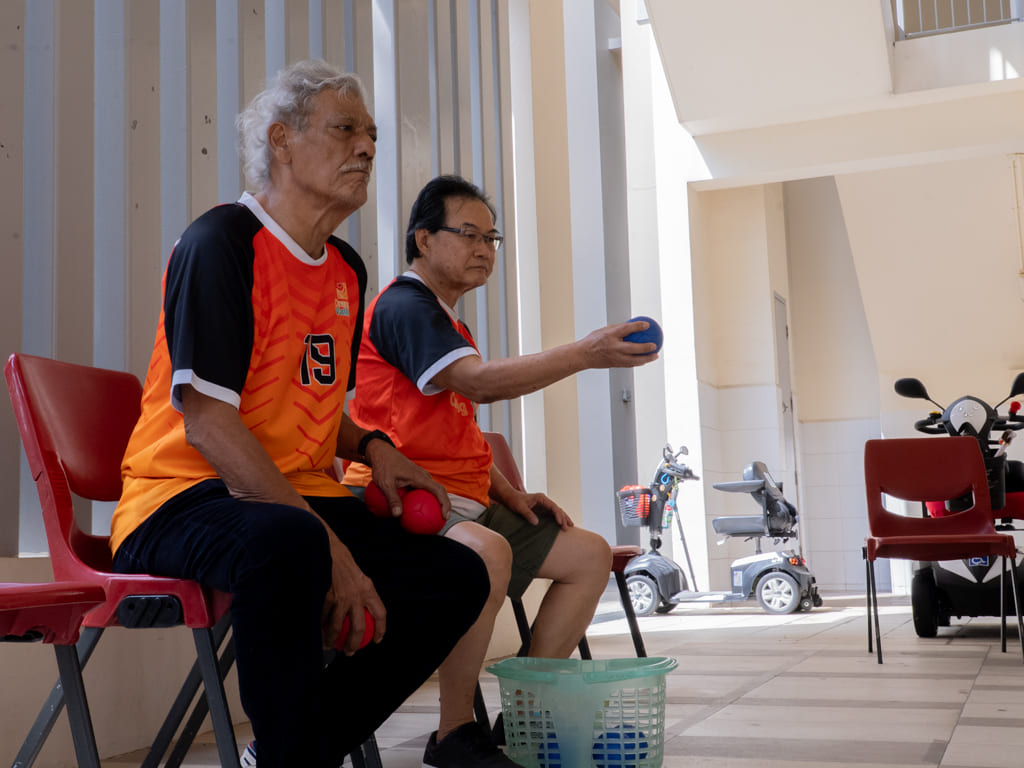
Adam Bin Ramli (left) and Ong Soon Kim (right) playing Boccia
When talking about Boccia, Adam and Soon Kim’s eyes light up. They finish each other’s sentences and eagerly chime in with great enthusiasm. Their lively chatter blends into one uninterrupted stream, a telltale sign of deep familiarity.
“The game looks easy, but it’s really not,” Soon Kim declares. “It’s not just luck. You cannot panic and must keep focused.”
The goal is to get your (or your team’s) coloured balls as close to the target white ball (called the “jack”) while ensuring the balls stay within the 12.5m by 6m court.
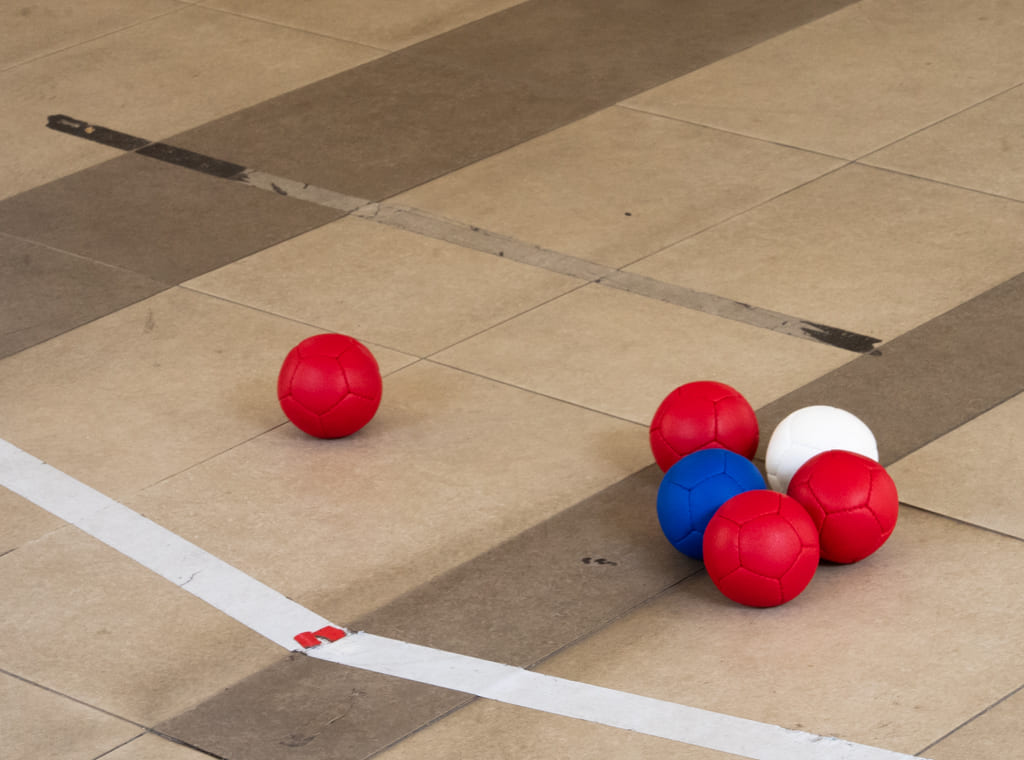
Boccia game – where the team aims to get their balls closest to the Jack (white line)
Adam explains that players must consider their strength and the accuracy of their aim. Players can throw, kick, or roll the ball and even release it down a sloped chute; those unable to let go of the ball themselves are allowed assistance.
Boccia can be played as an individual sport or in teams of two and three. During each round, teams get six throws and players take turns to release the ball. Points are tallied after all players have had their turn and the highest-scoring team wins.
“Being consistent with releasing the ball is the most important, and accuracy means practice. Practice is also very important to us because it helps us get to know each other,” Adam says.
How Boccia brings people together
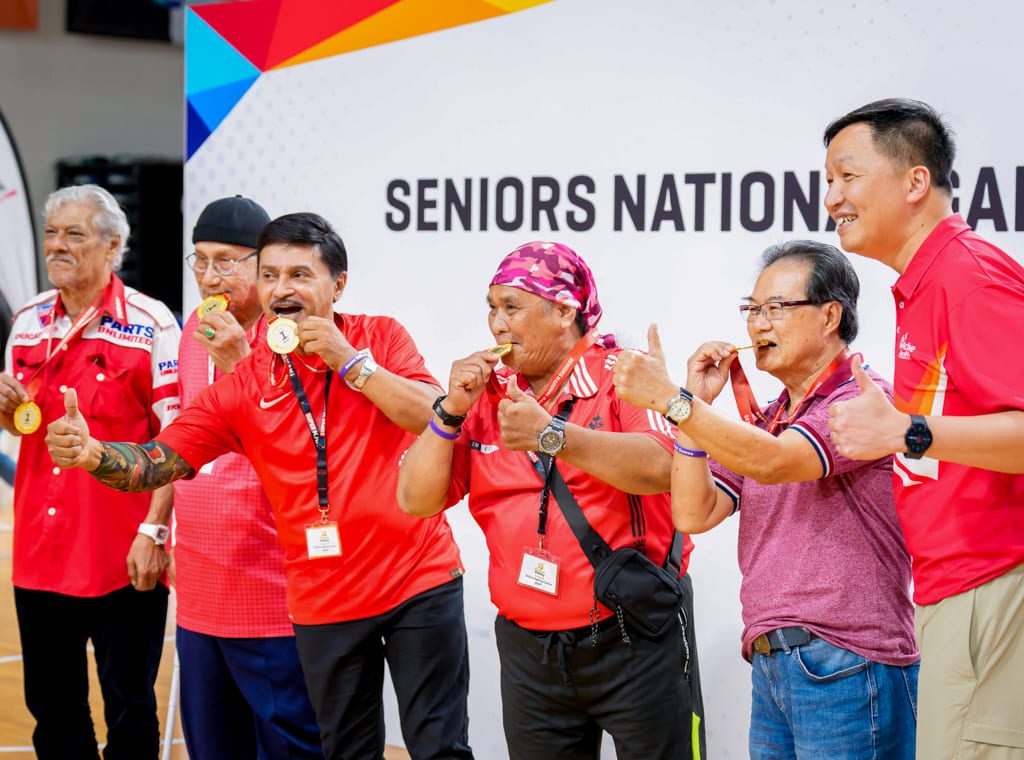
Orange Valley Active Ageing Centre @ Woodlands Peak Boccia Team posing with their medals and Marcus Tan, Group Chief at Sport Development Group (pictured far right), at the Seniors National Games Heats on 2 June 2026. (credits: SportSG)
In June 2026, the Orange Valley AAC Boccia Team won their matches at the 2026 Seniors National Games (SNG) (opens in new tab) Zonal Heats and advanced to the Finals. SNG, organised by Sport Singapore, was introduced in 2025 to inspire seniors to lead better, healthier and more fulfilling lives through sport.
It features five adaptive sports – Boccia, Disc Golf, Ladder Toss, Seated Floorball, and Sport Stacking – modified sporting activities designed to enable individuals of varying abilities to participate meaningfully.
In the lead-up to the Finals on 4 August 2026, the team has two-hour practice sessions three times a week. They hope their hard work will translate into a strong performance and a national championship title.
“When there is a competition, we are so eager. The most fun part about Boccia is when we win, of course lah. We play to win. Last year, there was a team we beat very narrowly; they are good, but we are better,” Soon Kim says to Adam’s laughter.
While both Adam and Soon Kim are competitive players and see medalling at the tournament as a goal, they agree the most important part of Boccia is “to be involved and enjoy the game”.
“If you’re only thinking of winning all the time, you’ll pressure yourself and get stressed,” Adam jokes.
Staying active, staying connected
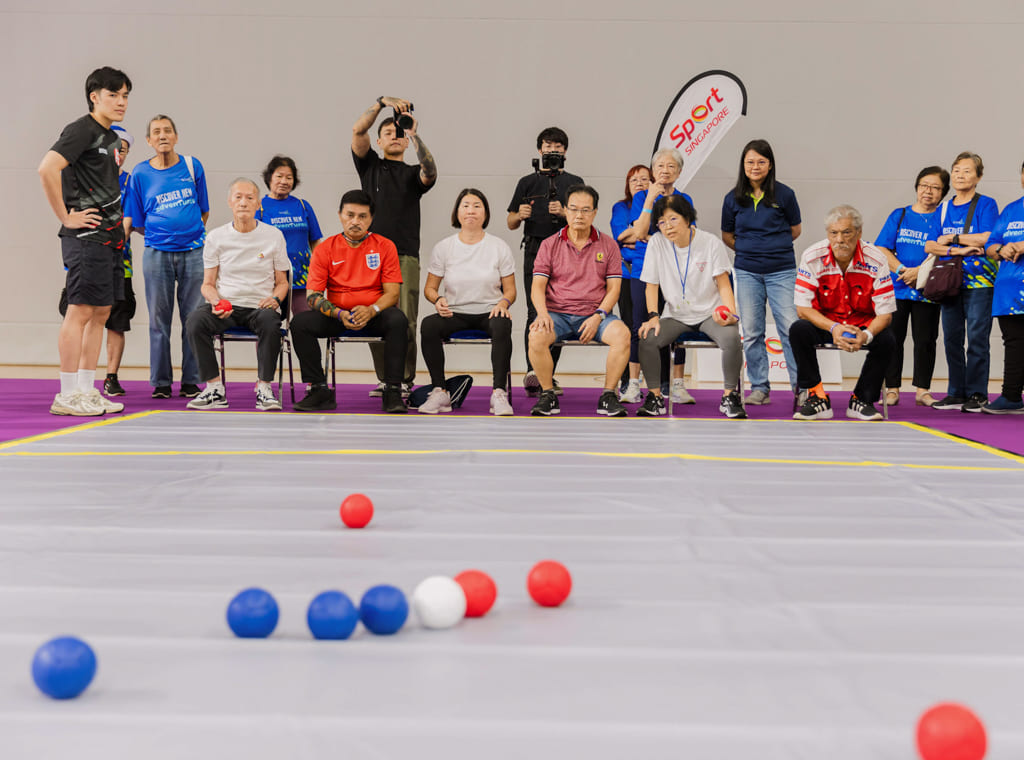
Adam and Soon Kim participating at the Seniors National Games Heats (Photo credit: SportSG)
Community and social connection lie at the heart of Boccia tournaments. After training, the team goes for kopi to discuss Boccia strategies and chit-chat.
At the SNG and National Healthcare Group (NHG) Boccia matches, they’ve made friends with other players all over Singapore. Soon Kim’s wife comes down to watch his matches, while Adam’s children and nieces have also expressed their support.
“The kampung spirit is there when you play Boccia. It’s nice to see your friends, and it gives us an opportunity to have conversations. We’ll ask, ‘How is your medical condition?’ and ‘Are you getting along well?’ Sometimes we give them a call so that they know we care,” Adam says.
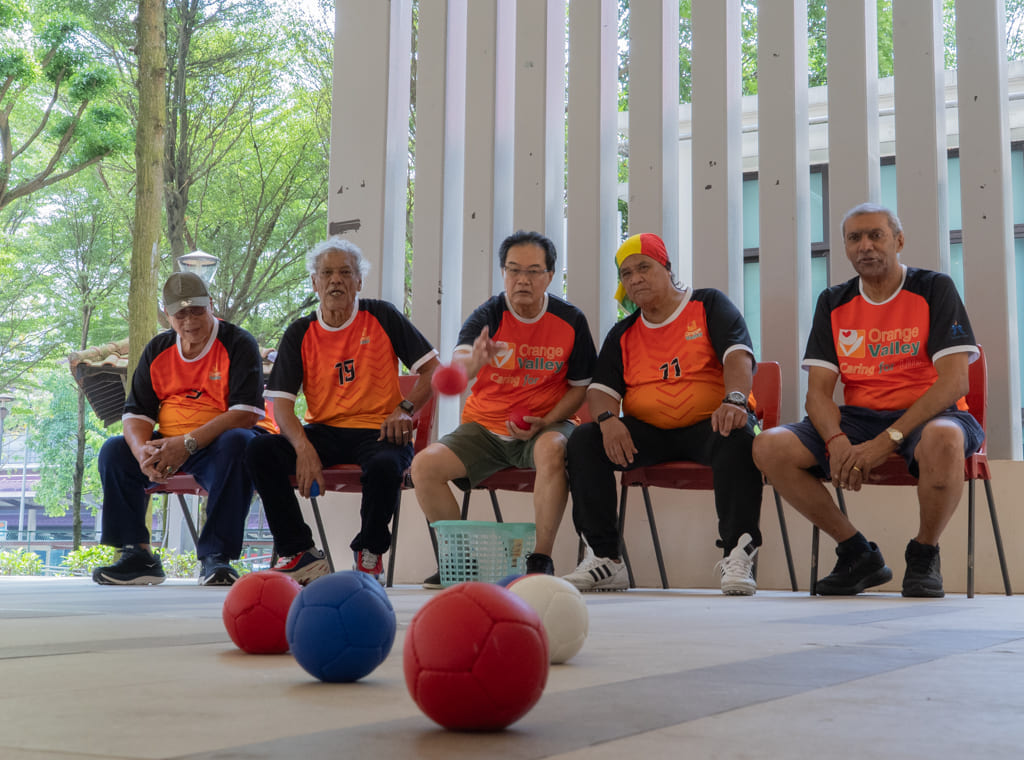
Orange Valley Active Ageing Centre @ Woodlands Peak Boccia Team training for the upcoming Senior National Games Finals
As retirees, both Adam and Soon Kim have found it to be extremely important to be part of a community, maintain a healthy social life, and remain involved in physical activity.
“Older folks need to pursue whatever activities they enjoy, be it karaoke or nature walks. The choice lies with you, but you must do something,” Soon Kim points out.
Adam agrees and encourages caregivers to bring seniors to their neighbourhood’s Active Ageing Centres or Residents' Committees to try new things.
He adds, “You can’t force the elderly to meet new people because everyone has different personalities. But you can at least reach out and invite them.”
Looking ahead as one Boccia community
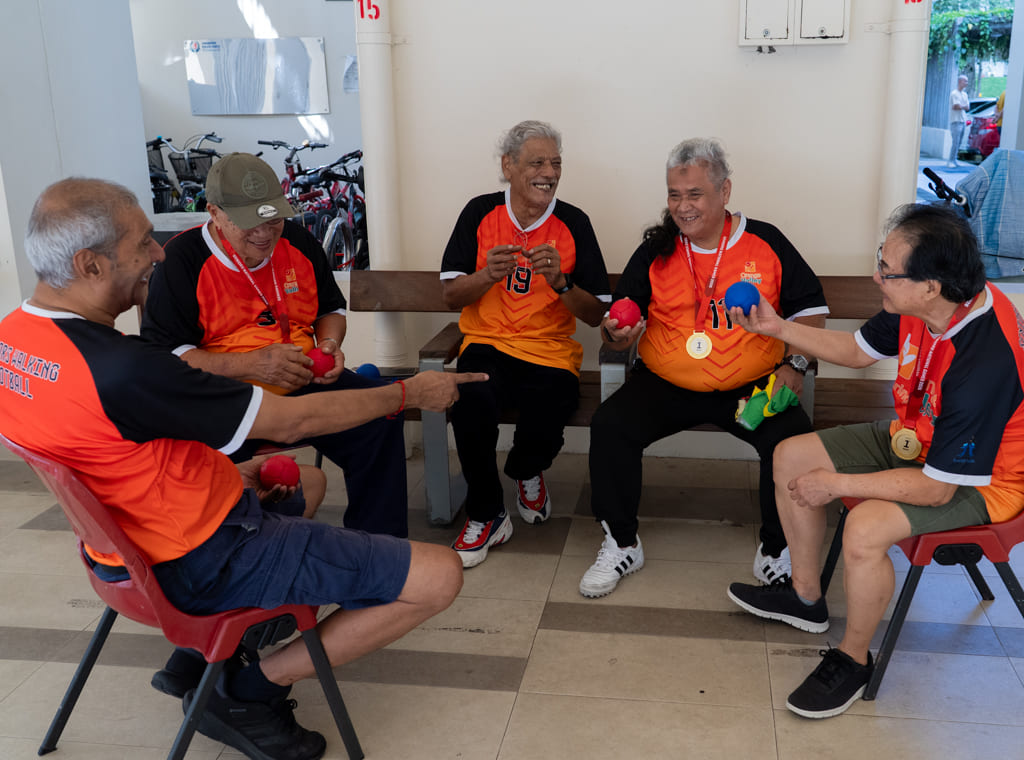
Team chats after their weekly training
Adam’s interest in the game has led him to attend referee courses under the Singapore Disability Sports Council (SDSC). Meanwhile, Soon Kim’s enthusiasm for the game grows, and he continues to look up new gameplay online from YouTube and AI chatbots.
Even when there are no ongoing competitive games, the pair still head down to socialise and play Boccia once a week. When there aren’t enough players, they play a virtual round of Boccia on their laptops. Ideally, they want more formal matches organised so there are more avenues to meet up.
“As players, we can only put in the request. We know it is hard work to organise more games. But our wish is that we can compete more often and continue to make new friends,” Soon Kim says.
Through Boccia, the two have gained many meaningful connections, shared passions, and a tight-knit community. They hope others, especially fellow seniors, will come watch or discover the game for themselves.
“You won’t know who you will meet. It could even be an old friend you lost touch with, or even an ex-colleague!” Adam says.
Cheer on Adam, Soon Kim, and the rest of the participating teams and sports at the Senior National Games Boccia Finals on 4 August 2026 (opens in new tab), from 9.30am to 1.00pm, at the Kallang OCBC Arena. There, you can discover how Boccia and other adaptive sports are keeping seniors active, connected and engaged in their communities.